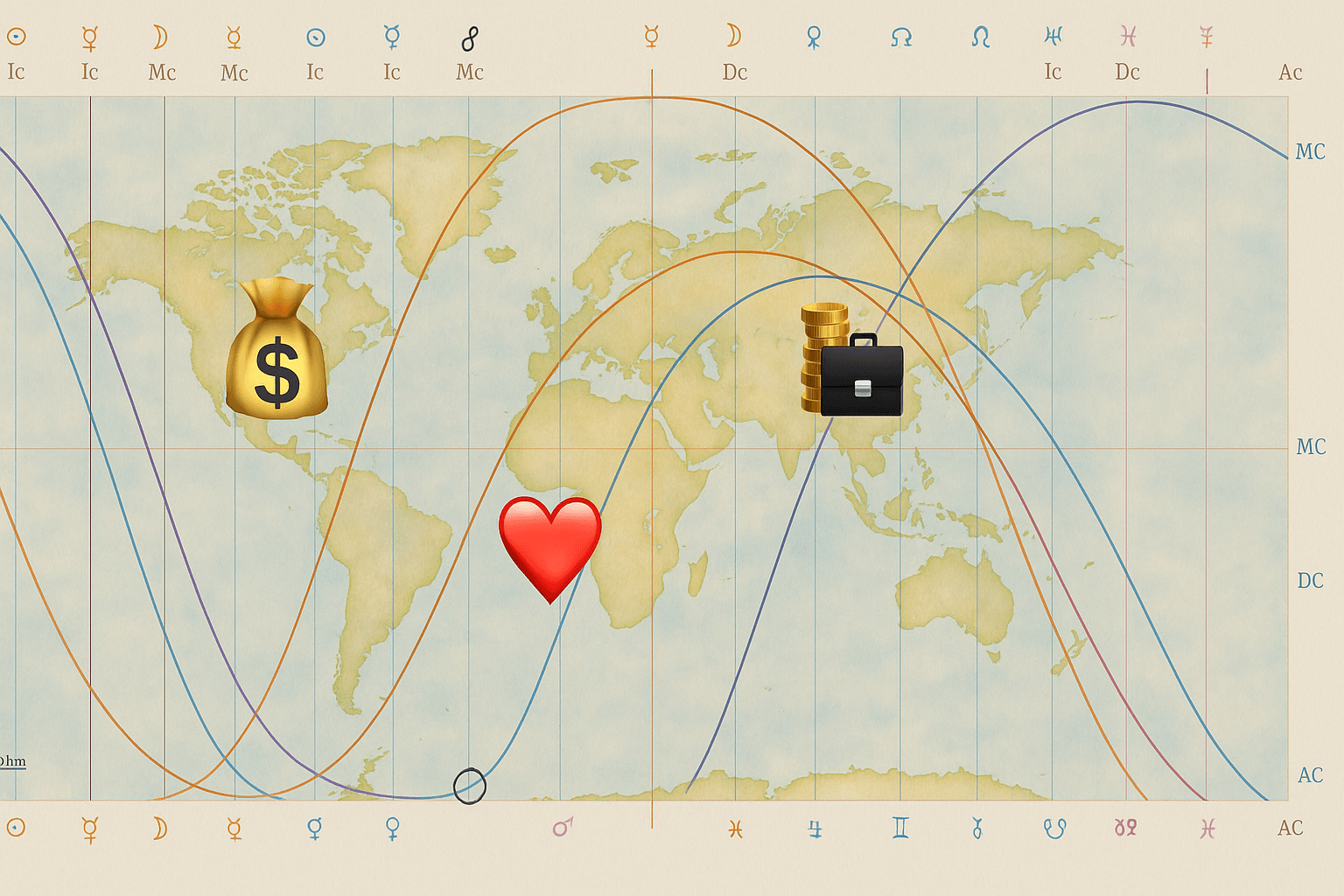
What an astrocartography calculator computes from your birth date, time and place, why one hour of error moves your lines a thousand kilometres, and how to read the result.
The Midheaven is the angle that counts commercially. Which planet suits scaling, launching or lasting, and why your location matters, not the registered one.
Match the trip length to the planet: fast lines register in days, Pluto in weeks. Which angles suit a holiday, and which lines to approach with some caution.
A complete reference for astrocartography lines: what the Sun, Moon, Mercury, Venus, Mars, Jupiter, Saturn, Uranus, Neptune and Pluto lines mean on each of the four angles.
Jupiter is leverage, not free luck. Which angle to choose for promotion versus patronage, why its orb is generous, and how overextension becomes the real risk.
Chiron is not a planet and its lines are quiet ones. What each angle exposes, why the wound surfaces before it heals, and why a defined end date helps.
Every competent astrocartography tool draws the same lines. What separates them is filtering, real zoom, angle labels, parans and honest handling of an unknown birth time.
Only one of your four Venus lines is really about partnership. How Venus DC differs from Venus AC, why spending rises, and when charm is not compatibility.
AC, DC, MC and IC mark where a planet rose, set, culminated or sat underfoot. Why MC lines run straight while AC lines curve, and what each angle quietly costs.
A crossing puts two planets at full strength in one place. Why the angles matter as much as the planets, how tight it must be, and how it differs from a paran.
Forty lines on one map is unreadable until you filter. The five-step method: read the labels, filter to one goal, measure distance, find crossings, then interpret.
Mars raises drive, temper and physical energy. Which angle aims that force at your work, your body or other people, and why short stays suit it best.
Mercury sharpens thinking, speech and trade. Why its lines always sit near your Sun lines, which angle suits study over negotiation, and how long to stay.
The Moon line is the settling line, not the happiness line. What separates Moon IC from Moon AC, why it stirs up the past, and when comfort becomes a trap.
Saturn removes the shortcuts. Why Saturn MC builds durable careers while Saturn IC deserves caution, and why leaving early costs you the entire return.
The nodes are eclipse points, not bodies, and read as direction rather than energy. Why growth here feels demanding, and why the South Node still counts.
Parans run east to west as bands of latitude, not north to south. Why they are ten times narrower than planetary lines, and best used to break a tie.
Test the line before you commit: its real character shows between weeks three and six. What the opposite angle costs you, and when the map should not decide.
The South Node line is where you are already competent. Why that makes it restorative and stagnating at once, and what the familiarity actually tells you.
You have four Sun lines, not one, and AC, MC, DC and IC behave very differently. How to tell them apart, how close to get, and when to visit rather than move.
Pluto works slowly and inwardly, so a weekend often registers nothing. What surfaces after a month, which angle digs deepest, and why timing matters most here.
Uranus disrupts quickly, Neptune blurs slowly. How each behaves on the four angles, why Uranus can act on a short trip, and where Neptune's escapism shows up.
How the map is built, why each planet gives you four lines, and why four minutes of birth-time error moves a line about 69 miles. A practical beginner's guide.
Astrocartography does not name one best city. It names the best city for a goal. How to match Venus, Jupiter, Moon and Mars lines to what you actually want to change.
Astrocartography, relocation charts and local space astrology answer different questions about place. How they fit together, and where Weltlinien and Astrogeographie fit in.